Starting from this weekend, the world is entering a ten-day period in which it will hold its breath due to elections to be held in three key countries.
On Sunday, 25 October (tomorrow), the second round of the presidential election is taking place in Brazil. Flavio Bolsonaro, representing the country’s rising fascism, will run against Lula, who has been the country’s most prominent political figure since the early 2000s.
On Tuesday, 27 October, parliamentary elections will be held in Israel. Genocide-criminal Netanyahu will be expecting approval from voters for the genocide he has pursued against the people of Gaza.
Finally, in the United States—the world’s most crucial power—there are the traditional “midterm elections” held halfway through the four-year presidential term. Even though Trump himself will not be running in these elections, both chambers of Congress (the institution corresponding to parliament in the US)—the Senate and the House of Representatives—will undergo elections. One-third of the Senate and the entirety of the House of Representatives are being renewed.
Considering that Trump’s political line is also oriented towards fascism, it would be correct to view all three of these elections as votes on fascism and genocide. In short, they are of immense importance. However, the truly major test will come in the spring of 2027 in France. In that country, Marine Le Pen, leader of the fascist party National Rally (Rassemblement National–RN)—the most established and powerful representative of 21st-century fascism—is leading by a wide margin in opinion polls for the presidential race. In summary, the world is entering an exceptionally intense period of 21st-century fascist revival.
Every country carries its own unique colours regarding historical experience in the arena of class struggles, diversity in the positioning of political forces, the balance of political power, and the ideological atmosphere. However, it has been a topic continuously covered in the pages of Gerçek newspaper for years that the defining worldwide characteristic of the 21st century in the current period (especially in the aftermath of the 2008 financial crash) is the resurgence of fascism for the first time since the 1930s. While the self-styled socialist intellectuals of the bourgeoisie and the wealthy modern petty bourgeoisie—alongside liberals on the right—have toyed around for decades with an intellectual plaything called “populism”, the Revolutionary Workers’ Party (Devrimci İşçi Partisi) has for years, nay decades been warning the Turkish and international left and the labour movement concerning the rise of fascism.
Now, faced with a fascist pole stamping its mark on elections in all the aforementioned countries—and a genocidal one in Israel—it is our duty to remain vigilant and reflect on the steps to be taken in line with the interests of the working class. The proletariat is an international class. Its politics must also be internationalist. Therefore, the vanguard workers of Turkey must not only monitor developments in other countries, but also reflect on what kind of policy should be pursued under existing conditions.
The Importance of Brazil
Brazil, which will be the scene of an election tomorrow, is a country of immense significance in many respects—both for its region and for the entire world.
Firstly, during Trump’s second term—in which he deepened his fascist policies—as everyone knows, the importance of Latin America has grown. Trump revived the Monroe Doctrine, a major feature of US foreign policy in the 19th century, combining it with his first name, Donald, to turn it into the “Donroe Doctrine”. According to this, the US is to be the sole hegemonic power in the Western Hemisphere. The main goal is to push China away from the Western Hemisphere and, on this basis, use the power gained thereby as a springboard for global dominance. Brazil, meanwhile, is the giant of Latin America with the largest economy; thanks to this, it acts as a “big brother” among Latin American states, and naturally its military power is superior to the others. Its industry and agriculture are exceptionally strong for a country dependent on imperialism, and it also possesses oil wealth.
Secondly, political balances in Brazil consequently exert a major influence on other Latin American countries. It holds enormous importance in determining the balance of power in the Western Hemisphere for the Shield of the Americas—established by the US earlier this year—which brings together Latin American countries under right-wing, reactionary, or outright fascist regimes. Many small and impoverished Latin American countries determine their policies by factoring in whichever forces hold power in Brazil.
Thirdly, Brazil is a member of BRICS. Although this international grouping (whose name derives from the first letters of Brazil, Russia, India, China, and South Africa) does not actually possess such potential—despite being fancifully viewed by some as a rival to US hegemony—it nonetheless constitutes a centre of power that China and Russia attempt to leverage in world politics.
Finally, and most importantly, Brazilian society, its working-class movement, and social struggles at large entered a powerful surge over the last half-century, starting around 1980. As a result, in the first half of that period, the Workers’ Party (PT)—in which Lula was among the leadership—was established as a united class party, trade unions made massive strides, landless peasants and the urban poor struggling with housing shortages built strong organizations, and women’s and Black movements organized and joined the struggle; in short, Brazil became the stage for major social battles. Towards the end of that period, current President Lula’s Workers’ Party (PT) climbed to power. Although this rise ground to a halt in the second half of the period (roughly from 2005 to the present day), the PT lost much of its former strength, and all the movements underwent a process of liberalization, the mass organizations of the previous era (such as the MST, the world’s most powerful peasant movement) remain standing and active. If fascism comes to power, it is possible that these movements will be crushed, or at least cornered under state repression and rendered unable to move.
Flavio Bolsonaro: Heir to a Fascist Father
In the presidential election, on one side stands Lula—a militant worker leader by origin who was carried to the position of president on the crest of this wave from 2003 to 2011 as a product of the aforementioned major social resurgence. On the other side is Flavio Bolsonaro, one of the sons of Jair Bolsonaro, who served as president between 2019 and 2023. The younger Bolsonaro is a member of parliament. The reason he is standing in the election instead of his father, who is still alive and well, is that the elder Bolsonaro is in prison. The cause for this speaks for itself: after Jair Bolsonaro (the father) lost the 2022 election to Lula, in January 2023—just as Trump did after losing the 2020 election, setting MAGA mobs upon the Capitol on 6 January 2021—Bolsonaro the father attempted a coup by inciting his supporters to attack all the buildings of power in Brazil. Thus, the younger Bolsonaro running for president today is merely a proxy for a coup-plotting father.
Not every coup plotter is a fascist. But the Bolsonaro family is fascist. Firstly, Jair Bolsonaro glorifies the military coup under whose clutches Brazil fell between 1964 and 1985, which ruled the country with an iron fist for 21 years (he himself is a former military officer). Secondly, he embraces the symbols of 1930s fascism both through its expression in the Brazilian experience and through international fascism—particularly via the Salazar regime in Portugal, Brazil’s former colonial power. Furthermore, like all fascists, he attacks “foreigners” to divide the working class. Finally, in an era where fascism is rising worldwide and Trump is gathering all right-wing and far-right movements in the Western Hemisphere under his wing, it would be a mistake to expect such right-wing movements to remain independent of fascism. In other words, even if the movement is not inherently fascist, it must be considered a near-certainty that it will become fascist.
The Socialist President Who Betrayed the Working Class Standing Against the Fascist Candidate
Lula—a politician who came to power on the basis of a programme promising “socialism” amidst the atmosphere of a giant strike wave in 1979 and the rising major struggles of the 1980s—is a president who fulfilled virtually none of his promises during his eight-year tenure between 2003 and 2011 (aside from a serious step forward in an anti-poverty programme known as the “bolsa de familia” or “family allowance”). Equally important is the fact that the leaders of Lula’s party, the PT, continually filled their pockets through bribery, extortion, commission-taking, and similar practices while serving at the highest levels of the state. This was so widespread that—despite high-ranking members of a party in power being naturally shielded behind a protective shield—countless PT ministers, MPs, mayors, advisors, and others were eventually tried and imprisoned. It would be no exaggeration to describe the Lula era as a “kleptocracy” (rule by thieves). Even Lula himself served time in prison as a result of a contentious trial after his presidency ended, though he was released when his conviction was later overturned.
This track record of Lula and his party has led certain sections of the global left, particularly many wings of the international revolutionary Marxist movement, to adopt a policy of abstaining from voting in the second round of the Brazilian elections.
The Revolutionary Workers’ Party of Turkey (DIP), as an internationalist party, has closely monitored Brazil throughout its history within the scope of its means. Our party opposed Lula’s submission to the yoke of the IMF even before he won the elections in 2003; after Lula became president, it exposed and criticized his failure to uphold even the simplest demands of the working and labouring masses, let alone the promise of socialism in the PT’s platform. Sungur Savran, the chairman of our party, demonstrated, on the basis of evidence that Lula had betrayed the working and labouring people in articles (in Turkish) published in the journal İşçi Mücadelesi in 2004 and the journal Praksis in 2006.
Despite all this, just as in the 2022 elections, the Revolutionary Workers’ Party also considers it correct to vote for Lula in the second round against a fascist candidate in the 2026 election. Fascism is a plague, a harbinger of barbarism, and a mortal enemy of the working class. We are not saying "a drowning man will clutch at a straw". Had there been a candidate facing Bolsonaro who openly represented the bourgeoisie, we too would have advised abstaining from the ballot box. Other wings of the bourgeoisie can never wage a consistent struggle against fascism. On the contrary, supporting the liberal bourgeoisie means paving the conditions for the rise of fascism. When opposing a vote for Macron against Marine Le Pen in the 2022 French elections, our newspaper Gerçek explicitly stated: "voting for Macron today is paving the way for Marine Le Pen to win tomorrow." Therefore, what needed to be done in that situation was simply to prepare for major post-election battles. However, if even Lula—the leader of the rightmost wing of the labour movement, and moreover of its corrupt apparatus—stands as a barricade against the victory of a fascist candidate, the votes must go to Lula.
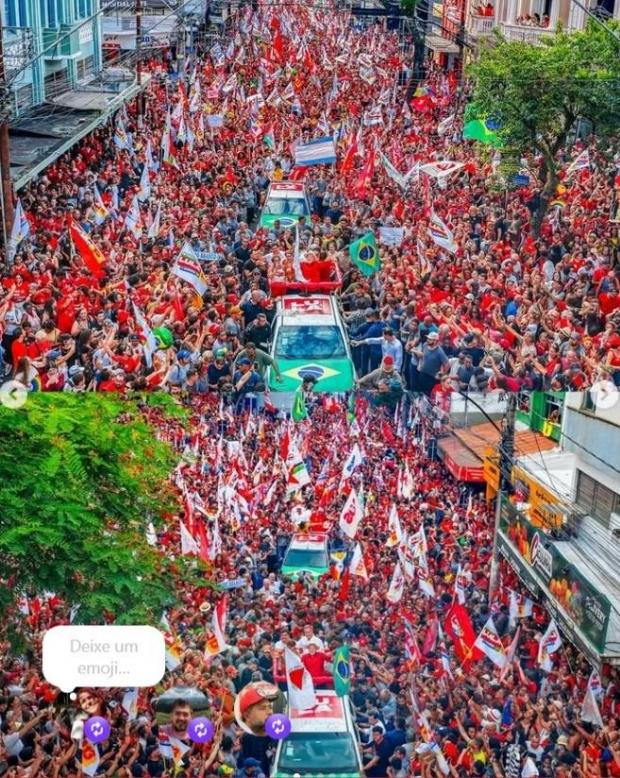
In the first round, Bolsonaro was ahead by two percentage points. Furthermore, there were three other minor right-wing candidates who were expected to call for votes for Bolsonaro. However, between the two rounds, a massive mobilization was observed among the working and labouring masses and the youth. For example, the photo at the top of this article was taken during Lula's visit to Minas Gerais state. It appears that the election will be closely fought.
For a long time, the global left failed to see or recognize fascism. Only when Trump’s MAGA mob stormed the Capitol did the left realize that fascism was at the doorstep. Now, it is perhaps paying the price for this delay. In order to project a left-wing image, to distinguish itself from the reformist quagmire, and to claim "I am the most revolutionary," it equates the fascist candidate with the right-socialist candidate.
Why should a party whose policy is revolutionary in all areas shy away from the most extreme application of the united front slogan against fascism? What could it possibly be bashful about?
Escalating the class struggle against fascism after the election will be the decisive move that can produce real results.