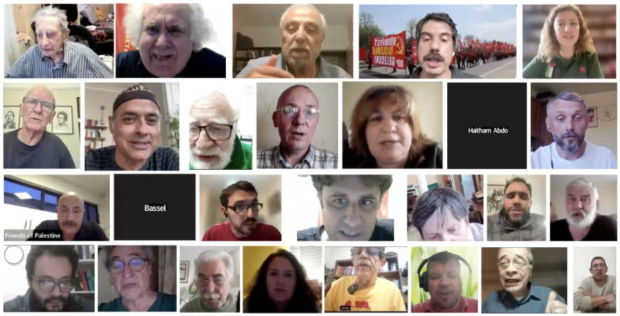
The Anti-NATO Conference, organized online on 4 July 2026 by the Christian Rakovsky International Socialist Center and the RedMed internet network, brought together speakers from 22 countries across five continents. Held in seven sessions and lasting approximately twelve hours, the conference constituted an important step toward bringing together the international forces determined to wage an unequivocal and uncompromising struggle against imperialism, Zionism and NATO, in response to the NATO Summit convened in Ankara on 7–8 July.
100-Year-Old Soviet Communist Guest of Honour Calls for the Destruction of NATO
Following the introductory remarks by Armağan Tulunay, who chaired the first two sessions and presented the aims of the conference, the floor was given to the guest of honour, Yosif Grigorovich Abramson, the hundred-year-old veteran who has devoted his life to the cause of socialism. Still an activist of the Russian Party of Communists (RPK) and a member of its Central Committee, Abramson brought to the conference the determination distilled from a century of struggle. Arguing that the reasons for the collapse of the Soviet Union and, more generally, of the twentieth-century socialist project have been fundamentally misunderstood, he also emphasized the opposition of Nâzım Hikmet, renowned Turkish poet in exile in the Soviet Union in the 1950s and the early 1960s, to Stalin. He concluded his address by stressing that the re-establishment of the Communist International was once again an urgent task.
Following this special tribute to a century of dedication to communism, the conference moved to its principal opening session, entitled "The World Today, the Role of NATO, and the Response of the Proletariat and the Oppressed Nations." The keynote speaker was the internationally renowned Marxist economist Michael Roberts, who opened the session with a detailed analysis of the world economy in the 2020s. Roberts argued that three broad alternatives lie ahead. In his own terminology, these are: the continuation of the "Long Depression" into the 2030s; the replacement of the present crisis by a period of economic revival resulting from factors including technological revolution; or the descent of the world into the catastrophe of war, accompanied by the establishment of fascist or military regimes.
Following Roberts, the organizers of the conference—the Rakovsky Center and RedMed—together with the two parties that had played the leading practical role in organizing the event, delivered their opening addresses.
Speaking first on behalf of the Christian Rakovsky International Socialist Center and the Workers' Revolutionary Party (EEK) of Greece, conference co-organizer and EEK General Secretary Savas Michael-Matsas summarized the analysis of the world situation largely shared by the EEK and the Revolutionary Workers' Party (DIP), emphasizing the nuclear annihilation threatened by an emerging Third World War. Referring to a recent article by Francesca Albanese, the United Nations official from Italy responsible for the question of Palestine, he stressed her argument that the genocide in Gaza has become a mirror through which everyone must judge themselves. He also highlighted Albanese's conclusion that a "global revolution" is beginning to emerge in response to the genocide. He concluded by underlining the necessity of building a revolutionary International in the spirit of Leon Trotsky,.
Speaking next on behalf of the other organizing bodies—the RedMed internet network and the Revolutionary Workers' Party (DIP)—Levent Dölek, Deputy Chairman of the DIP, declared that "If you scrape away NATO blue, you will find the brown of fascism underneath." He exposed NATO's historical record through a wealth of historical evidence. Tracing the decisions adopted at recent NATO summits, Dölek drew attention to the Alliance's increasingly aggressive policies and argued that the struggle against NATO must occupy the very center of the anti-imperialist struggle. He explained that the Revolutionary Workers' Party has conducted this struggle under the slogan "Leave NATO, Destroy NATO." He further noted that the DIP had been the only political party to advance the call for a general strike against the NATO Summit in Ankara, that it had taken concrete steps to carry this campaign into the ranks of the working class, and that only the working class possesses the power capable of defeating NATO.
Communists of the Former Soviet World Meet at the Anti-NATO Conference
The conference then proceeded to its third session, entitled "The Future of Eurasia." Particularly striking was the strong participation from the land of the former Soviet Union. Five organizations from Russia and Ukraine were represented in this session, with six different speakers taking the floor. Contributions came from the United Communist Party (OKP), the Russian Communist Workers' Party (RKRP), the Association of Marxist Organizations, and the Soviet Union Association. (Abramson, representing the Russian Party of Communists (RPK), had already addressed the conference in the earlier session.)
Darya Mitina, International Secretary of the Central Committee of the United Communist Party (OKP), emphasized the importance of the Anti-NATO Conference while exposing NATO's imperialist war against Russia in Ukraine and the role played by Ukrainian Nazis in that conflict.
The Russian Communist Workers' Party (RKRP)—the second-largest communist party in Russia after the much larger but only nominally communist KPRF (Communist Party of the Russian Federation), contributed to the conference through a written message. Declaring NATO to be the principal aggressive force of our epoch, the RKRP expressed solidarity with peoples resisting imperialist aggression from Cuba to the Sahel and Palestine, and emphasized the urgent need for Leninist parties in the struggle against imperialism.
The session continued with presentations on behalf of the Association of Marxist Organizations and the Soviet Union Association, as well as a contribution by investigative journalist Said Gafourov. Particularly significant was the participation of Yuriy Shahin, who joined the conference from Crimea, a territory subjected to intense bombardment by Ukraine using weapons supplied by Western imperialism. Although the frequent electricity cuts—making Crimea resemble Cuba in that respect—prevented Shahin from participating live, he succeeded in bringing the voice of Crimea and of the anti-imperialist minority within Ukrainian society to the conference through a pre-recorded video message.
The final speaker of the session, Sushovan Dhar, joined from India, the giant of Asia. He analyzed the contradictions of the world economy and described the difficult economic conditions confronting the countries collectively referred to as the Global South.
Revolutionaries from West Asia and North Africa Stand Shoulder to Shoulder in the Struggle Against NATO
One of the most remarkable parts of the conference was the session devoted to West Asia. Revolutionaries from Palestine, Lebanon, Algeria and Turkey took the floor alongside representatives of revolutionary groups from countries such as Romania and Greece, which, although situated in Europe, are actively engaged in the struggle for the victory of the Palestinian cause.
The session opened with a keynote address by Vijay Prashad, the Indian Executive Director of the Tricontinental Institute for Social Research. Prashad began by describing Sungur Savran, Chairman of the Revolutionary Workers' Party (DIP), as "a legend" among anti-imperialists, adding that he was delighted to be participating in the same conference with him.
Speaking at a brisk and compelling pace that held the audience's attention throughout, Prashad began by discussing the recent defeat suffered by the United States in its conflict with Iran before turning to the broader crisis of imperialism. He lamented the extent to which even within revolutionary circles many continue to believe imperialist propaganda. Above all, he insisted that socialist movements emerging from different Marxist traditions—and particularly those holding divergent assessments of China's socio-economic and political character—must nevertheless distinguish between their programmatic, strategic and tactical differences and unite in action against imperialism, Zionism and NATO despite those disagreements.
The first speaker representing West Asia was Haitham Abdu, who had travelled in person to Istanbul to oppose the NATO Summit. Speaking on behalf of the Popular Front for the Liberation of Palestine (PFLP)—the organization of George Habash and Ghassan Kanafani, symbolized by the red of the Palestinian flag—Abdu addressed the conference in Arabic, with consecutive interpretation into English. A member of the PFLP Central Committee responsible for Lebanon, he conveyed the greetings of the martyrs, the prisoners and those who continue to resist.
"We did not choose resistance because we are enamored of death; we chose it because we are committed to a life of dignity." He emphasized that the Palestinian people present themselves before the world not as supplicants but as a people standing upright in resistance. What Palestine needs from its friends, he declared, is not tears but clear political positions.
Following Abdu, representatives of another great socialist tradition of West Asia joined the conference from Lebanon. Addressing the participants, a Lebanese communist militant presented a detailed overview of the political situation both in Lebanon and throughout the region. He devoted particular attention to the latest wave of war waged by Zionist Israel against Lebanon, the resulting displacement from southern Lebanon, the human suffering this has produced, and the efforts of anti-imperialists to confront this crisis.
Although the scheduled speaker representing the Popular Front for the Liberation of Saguia el-Hamra and Río de Oro—better known as the Polisario Front—was ultimately unable to participate because of logistical difficulties, North Africa was represented by the Algerian economist Abdelatif Rabeh. Recalling the glorious political legacy of the Algerian Revolution, which expelled French colonialism after the revolutionary war of 1954–1962, Rabeh argued that although a process of degeneration had begun in the 1980s, the national liberation perspective embodied by the Algerian Revolution remains fully relevant today.
The next speaker was Kutlu Dâne, spokesperson for the Friends of Palestine Against Imperialism and Zionism in Turkey. Accompanied by a rich visual presentation, Dâne’s speech described the campaigns carried out in Turkey in solidarity with the Palestinian cause. He argued that Palestine functions as a litmus test for Erdoğan's authoritarian regime while simultaneously serving as a rallying point that unites anti-imperialist forces internationally.
Dâne explained that the campaigns conducted by his organization seek not only to oppose Israel and support Palestine but also to help Palestinian socialists win political leadership within the Palestinian movement itself. He stressed that the ideological struggle against the reactionary illusion of a so-called two-state solution, together with efforts to win over the anti-Zionist Jewish movement, constitute essential components of this broader struggle. He concluded by emphasizing the need for international platforms capable of deepening both the struggle and the resistance.
The conference also heard from the Balkans region, form a representative of Romania's ELBIT OUT! campaign, which organizes solidarity with Palestine, and from Ernesto Angelis of the Greek EEK, both of whom presented reports on their activities. The Romanian speaker, in particular, illustrated with statistical evidence the importance of Romania as a hub for ELBIT Systems, one of Zionist Israel's most notorious arms manufacturers, and described the campaigns being conducted against the company.
Fighting NATO from Within NATO
The fourth session, entitled "NATO and Europe in the Age of Fascism and Militarism," brought together speakers from a number of European countries, especially NATO member states.
The opening address was delivered by Dimitris Mizaras of the Marxist Workers' League of Finland, who criticized NATO's expansionism by referring to Finland's accession to the Alliance in 2023.
Speaking on behalf of the French organization ROR (Revolutionary Proletarian Renaissance), G. Bégéneix argued that Emmanuel Macron's government belongs to NATO's most hawkish faction, pointing to provocative proposals such as sending French troops to Odessa. He further reminded participants that France has been implicated in every NATO war conducted under U.S. leadership. Bégéneix also emphasized the importance of defending Cuba under the leadership of its working class.
Representing Poland, Ewa Groszewska observed that public support for NATO remains very high in her country. She argued that the Polish left has virtually abandoned opposition to NATO, leaving that political terrain to monarchist parties. As a result, even left-wing voters, trapped between competing pro-NATO parties, sometimes find themselves casting their ballots for monarchist forces.
A written contribution submitted by the Romanian Marxist philosopher Ana Bazac echoed many of Groszewska's observations regarding the impasse facing the Polish left. Building her intervention upon a philosophical foundation, Bazac outlined what she believes a genuinely consistent left must do under present conditions. A more detailed version of Bazac’s ideas on this question may be found in the 2026 Edition of the journal Revolutionary Marxism, which may be consulted online.
Albania also featured prominently during this session. The country has recently witnessed a wave of popular protests against attempts by the family of U.S. President Donald Trump to appropriate Sazan Island, one of Albania's outstanding natural treasures. Speaking from Albania, Manolis Seras shared his observations on what has come to be known as the Flamingo Revolution, which has shaken the country for weeks.
Joining the conference from Northern Cyprus, Yusuf Aydın recalled the great anti-colonial struggle launched by the Cypriot working class against British rule during the 1940s. He argued that Britain and the United States deliberately transformed this anti-colonial struggle into a conflict between the island's two communities by fomenting communal antagonism. When the Republic of Cyprus, established in 1960, aligned itself with the Non-Aligned Movement, thereby becoming a threat to imperialist interests, Britain concluded, together with the United States, that partitioning the island would best safeguard its military bases, which have turned Cyprus into an "unsinkable aircraft carrier" threatening the peoples of the Eastern Mediterranean. Aydın stressed NATO's and imperialism's overwhelming responsibility for the present situation.
Speaking for the EEK, Yannis Angelis analyzed the condition of the European Union, whose relationship with the United States within NATO has become increasingly unstable. He argued that although the European bourgeoisie played an important role in the capitalist restoration of Eastern Europe following the events of 1989–91, it failed to emerge as a unified political actor during the subsequent Ukraine crisis and therefore could not assume a decisive role. The same fragmentation, he maintained, continues to characterize the European bourgeoisie under today's emerging "war economy."
Speaking on behalf of the Revolutionary Workers' Party, Burak Saygan reviewed NATO's bloody history in Turkey. He explained that the DIP, operating in a NATO member state, regards the defense of Cuba, Iran and Palestine as inseparable from the struggle against NATO within Turkey itself—a struggle that it seeks to wage in the heart of the working class. He expressed the hope that this conference would mark the first step toward creating lasting international platforms capable of bringing together revolutionaries fighting against NATO.
The internationalist organization Bolshevik Tendency also addressed the session as a guest. Summarizing its assessment of NATO, the world situation and the current European conjuncture, it concluded by calling on all participants to intensify the struggle.
Latin American Anti-Imperialism Also Represented at the Conference
The fifth session of the conference was devoted to Latin America.
The opening address was delivered by Osvaldo Coggiola, professor of history at the University of São Paulo and one of Latin America's foremost Marxist intellectuals. Coggiola argued that recent developments have exposed both the limitations of reformist centre-left projects and those of bourgeois nationalism throughout Latin America. He maintained that the Latin American revolution must transcend these limits and unite the continent under the leadership of the working class if imperialism is to be defeated.
The participation of representatives from Cuba, a country that the international working class must defend as the apple of its eye against the relentless aggression of U.S. imperialism, was one of the conference's most significant features. Frank García Hernández, speaking on behalf of the group Comunistas (Communists), addressed the conference with a speech enriched by anecdotes drawn from the history of the revolutionary struggle.
This was followed by two important contributions from Venezuela. Speaking on behalf of En Lucha (In Struggle), Luis Bonilla Molina argued that the Rodríguez government, which came to power following U.S. intervention, functions essentially as a colonial administration. At the same time, he stressed that the situation in Venezuela remains highly explosive.
Similarly, José Capitán, representing Opción Obrera (Workers' Option), maintained that the Rodríguez government has capitulated to U.S. imperialism and to Donald Trump. In his view, the present government has retreated even from the legacy of Bolivarianism. Capitán argued that Venezuela should sever all relations with the United States.
The conference also received a video message from Juan Marino of Argentina's Partido Piquetero—named after the powerful movement of unemployed and impoverished sections of the working class known in Argentina as the piqueteros. Marino argued that important mass movements are emerging in response to the growing danger of war. He insisted that revolutionaries must develop a response commensurate with the level reached by these popular mobilizations, called for closer collaboration among revolutionary forces, and appealed for the creation of an anti-imperialist united front.
Further contributions were made by Ítalo de Aquino, representing Crítica Socialista (Socialist Critique) in Brazil, and Sebastian Sarapura Rivas, of Perspectiva Socialista (Socialist Perspective) in Peru, both of whom discussed recent political developments in their respective countries and across the region.
Finally, the Liaison Committee for the Construction of the Fourth International (CERCI), active in several Latin American countries, greeted the conference with a written message. It argued that the world order established after the Second World War has now come to an end, and stressed that the struggle against U.S. imperialism and NATO can succeed only if the working class is organized around a program of social revolution. CERCI belatedly also sent a video recording of a speech by one of its leaders, which unfortunately could not be projected during the conference.
Closing Session: Forward to Defeat NATO!
In the closing session, representatives of the organizing bodies assessed the conference and shared their views on the tasks that lie ahead in light of the discussions and conclusions that had emerged.
Speaking on behalf of the Christian Rakovsky International Socialist Center and, as General Secretary, on behalf of the Workers' Revolutionary Party (EEK) of Greece, Savas Michael-Matsas underlined the great success of the conference. He argued that the substantial participation from different continents and regions points to a new awakening within the world socialist movement. He also emphasized that the analyses presented concerning the world situation and the policies of imperialism have identified entirely new historical realities.
Michael-Matsas stressed that humanity now stands at the threshold of an entirely new historical epoch, making it imperative to weigh every development with the utmost care before drawing conclusions. He insisted that the capacity of Marxist theory to grasp the true nature of this new period depends precisely upon such rigorous analysis.
The conference's concluding address was delivered on behalf of RedMed by Sungur Savran, speaking in his capacity as Chairman of the Revolutionary Workers' Party (DIP).
Savran observed that a broad consensus had emerged during the conference that the world is passing through a profound economic depression and that this constitutes the underlying factor behind both the rise of fascism across almost every continent and the growing threat of a Third World War.
He argued that this analysis should be supplemented by another phenomenon on which the DIP has consistently insisted ever since the financial collapse of 2008: namely, the successive waves of revolution, popular uprisings and anti-imperialist insurgencies that have shaken different parts of the world—first in the Arab world and on the northern shores of the Mediterranean between 2011 and 2013; then in another series of Arab countries and throughout Latin America during 2018–2019; and, most recently, across the Indian subcontinent and in various African countries.
In contrast to these mass revolutionary tendencies, Savran argued, the international left has suffered an enormous collapse following the disintegration of the socialist experiences of the twentieth century, above all that of the Soviet Union, the homeland of the October Revolution. He maintained that one of the defining contradictions of our time lies precisely in the contrast between the revolutionary aspirations emerging among the masses and the weakness of the socialist movement.
Savran concluded by stressing the great importance of the consensus achieved at the conference. Calling upon all participants to engage actively in the struggle, he argued that revolutionaries on every continent must fight together on the basis of an uncompromising anti-imperialist policy directed against NATO, imperialism and Zionism. With this appeal, he formally brought the conference to a close.