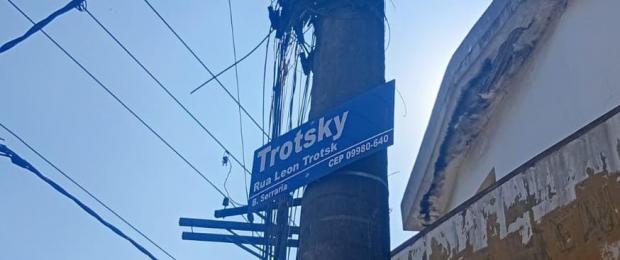
The photo above was shared two days ago via social media by a comrade of ours, a revolutionary Marxist from Brazil. As he was sharing it, he added a remark, writing “sensacional” in Portuguese. The photo has probably circled the equator hundreds of thousands of times during the last several days. Trotskyists across the globe have probably shared with one another their immense joy upon learning that a street in the municipality of Diadema—within the heartland of the Brazilian proletariat, São Paulo—has been named after the great hero of revolutionary Marxism, Leon Trotsky.
What else could explain such jubilation from a veteran revolutionary Marxist comrade—someone who, in his youth, went through the Dantesque experience of the military dictatorship in Argentina between 1976 and 1983, resisted Lula’s successive betrayals in Brazil, his adopted home, a man who has over time been a party leader, a historian, the author of 90 books, and a seasoned intellectual? Indeed, the post reads "forwarded many times." Our comrade was right: the news was truly "sensational."
Why sensational? Because through the dedicated efforts of the proletarians and the impoverished inhabitants of the favelas (shantytowns) of São Paulo—a population that has waged perhaps the most vibrant socialist struggle in the world over the last half-century—a street has been named after Trotsky. We learn from the internet that the settlement in question, which came into being as a result of a mass struggle, including land occupation, for social housing, was named Villa Socialista in 1990. It was these proletarians and the urban poor who named the streets, including this one, after revolutionaries, and then the municipal council that ratified them through its Lei Municipal No. 1113. (These administrative numbers are sometimes so important in countries like Brazil and Turkey!) This marks what might be the very first time in nearly a century that a street has been named after a hero of the proletariat who was the victim of an assassination 86 years ago today, on August 20th, through a plot orchestrated under Stalin's personal orders, and who succumbed to his injuries the next day, on August 21st.
Consider this: during the 1905 Revolution, when only 26 years old, this man was elected chairman of the workers' soviet in St. Petersburg—the capital and primary proletarian centre of Tsarist Russia. In the 1917 Revolution, he was re-elected president of the newly established Petrograd Workers' and Soldiers' Soviet (the same city under a different name). By then he had become a Bolshevik. In his capacity of chairman of the Soviet, he became also the chairman of the Revolutionary Military Committee, which planned and successfully led the insurrection of October 25 (November 7 in the new calendar). While Lenin was in hiding in Finland, persistently calling on his comrades to take power through an uprising, it was Trotsky who led the insurrection on the ground.
In the first Soviet government, with Lenin as Prime Minister, Trotsky served as Foreign Minister. He was the man who exposed secret diplomatic documents to the peoples of the world and revealed to the people of Turkey, in fact then the people of the Ottoman state, that their capital city, then called Constantinople and now Istanbul, was promised to the Tsar under an agreement among the Entente powers. As the founder of the Red Army from scratch and later its commander, he swept through the Whites—who were backed by fourteen imperialist nations—aboard his famous armoured train. He was one of the two honorary chairmen of the Communist International founded in 1919 (the other, of course, being Lenin). Trotsky was also a Marxist intellectual who engaged in fierce polemics with world-renowned intellectuals of the bourgeoisie of the first half of the 20th century, exposing them using his prose—no less poetic than that of Pushkin or Mayakovsky, the greatest Russian poets—like a scalpel, leaving them with no choice but to flee without even looking back. For the time being, he remains the highest summit among Marx's intellectual heirs.
What came after (if you were to ask him) was even more significant than what we have already mentioned. Through his internationalist struggle against the derailment under Stalin's leadership of the world revolution that had begun in October 1917, through his fully Marxist analysis of this degeneration in The Revolution Betrayed, and by founding the Fourth International—a relatively weak organization replacing the Communist International dissolved by Stalin in 1943, yet one whose banner still continues to be raised 90 years later in the great struggles of the world proletariat—Trotsky established himself among the greatest Marxist revolutionaries of the 20th century. These contributions served as a kiss of life for the world proletariat and internationalism during the darkest moments of the 20th century.
Although the state founded under the leadership of Lenin and Trotsky collapsed 35 years ago, it remains the greatest beacon of hope in human history. For a long time, far beyond merely having streets named after him, Lenin was a leader whose statues were erected all around the world, and who was even mummified both literally and, unfortunately, also figuratively. On the other hand, we have no idea how many streets in how many cities and countries have been named after Trotsky. There is a slight chance such a moment occurred during specific revolutionary periods—such as in Turin in during the Biennio Rosso of 1919-1920, China in 1925 or 1927, or Spain between 1936-1939, especially Barcelona in 1937. Notice that all these examples come from before the Second World War. Following the war, after Stalinism established itself as an international system, the likelihood dropped drastically, even during periods of revolution. Perhaps during the 1952 Bolivian Revolution, where Trotskyists were contenders for leadership. Perhaps in a "liberated" mountain town temporarily captured by Trotskyist guerrillas in Peru or Argentina in the 1960s. Or perhaps in a "red" city in Sri Lanka during the 1950s and 1960s, when Trotskyism was the dominant socialist movement. We will only be able to celebrate these and other examples once historians uncover them. Even so, it would be surprising if they exceeded the fingers on two hands.
Now, return to the beginning and read once more about this figure of the 20th century, to remember what kind of person we are talking about. Then consider this: across the roughly 200 countries of the world, in thousands—and in some cases tens or hundreds of thousands—of cities and towns, imagine how many streets are named after bloody dictators, bloated capitalists, political fraudsters, ruthless generals, incompetent bureaucrats, thieves, scoundrels, mediocre writers, “famous artists”, and millions of people whose names no one will ever remember. Yet, there was probably not a single street named after one of the two founders of the glorious Union of Soviet Socialist Republics—a state that struck terror into the hearts of global capitalists and NATO generals for nearly the entire 20th century. Or rather, there wasn't one until now. Now, there is (no one knows for how long of course). Truly sensational, comrade. Or, to use that incomparable word shared by the two beautiful languages of the Latin world: fenomenal!
It seems only yesterday when we were saying, "we are entering the 21st century." In almost the wink of an eye we came to the point of saying we had now completed the first quarter of the 21st century. Today, we are halfway through 2026 and heading toward its end. Only one full year remains in between. The year 2028 will mark the 90th anniversary of the founding of the Fourth International. Let us place that milestone at the centre and bring the unvarnished story of the revolution and counter-revolution of the 20th century to all the peoples of the world. Let us bring it to them so that we can re-arm ourselves to survive the impending showdown that threatens fascism, world war, the nuclear threat, and climate catastrophe.