1. The role of local elections in French political life
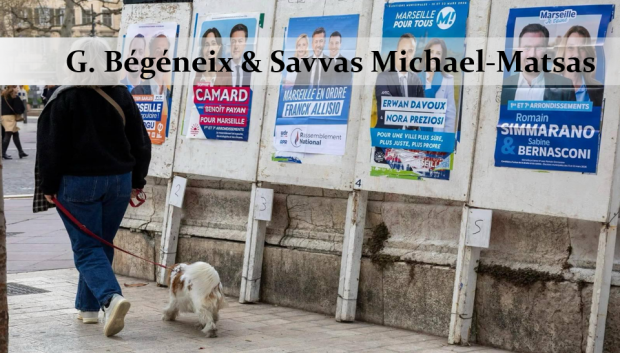
In France, local elections enable citizens to elect and appoint the mayor of their town or village.
The mayor’s remit is local in scope (roads, maintenance of state schools, social services, municipal health centres, etc.)
As a result, until just a few years ago (particularly in the provinces), the mayor was relatively close to the people they governed. People were familiar with their views, their lifestyle, and so on. Turnout was traditionally quite high (i.e. low abstention).
However, politicians from the various bourgeois parties, acting at the national level and from the centre in Paris, have gradually imposed “reforms” that have stripped mayors of an increasing share of their power. Then, these “neo-liberal” politicians abolished local tax, thereby depriving local authorities of funding. With the latest ‘reform’, the voting system has also changed: the right to “mix and match”, which allowed voters to cross out names on a list or add new ones (meaning that a citizen who had not stood as a candidate could still be elected – or even become mayor – ) has been abolished. Following this reform, in two out of three local authorities (i.e., 23,700 out of 34,875 local authorities nationwide as of 1 January 2025), the political choice has been limited to a single list. (The primary reason for abstention).
Further ‘reforms’ have served to distance the citizen-voter from their town: the proliferation of hierarchical levels between the local council and central government. The mayor (the town hall) has seen the emergence of decision-making bodies that have stripped them of some of their powers (inter-municipal bodies, the region, the Prefect (who is unelected), etc.) In the ‘popular’ perception, politics was what could change things (life). Yet, in the suburbs (now extended to rural areas) at all levels, politics can no longer change anything. Technocratic choices have consciously and deliberately stripped ‘democracy’[1] of its substance. Voter abstention, which was already affecting other types of elections (European, presidential, parliamentary, etc.), now also affects local elections. In certain municipalities (ranging from some Socialist Party elected representatives – see Hanotin in Saint-Denis, or Delga in Occitanie – to the far right), local democracy has also been severely undermined. Neoliberal authoritarianism has taken hold.
As early as 29 May 2005, the French had overwhelmingly rejected the draft “Constitutional Treaty” for Europe. Yet Sarkozy, once elected President, simply disregarded the result of that referendum.
But the final blow came on 9 June 2024 when Macron dissolved the National Assembly and then refused to take account of the result of the new elections, raising questions about the legitimacy of political power, if not its legality. Ultimately, with this “quasi-coup d’état”, a form of census suffrage has been reinstated. Macron is the counter-revolution!
At the local level, citizens no longer have any power. The poorest, wherever they may be, no longer vote. Why bother voting anymore?
It is these various factors that account for the 43% abstention rate in the 2026 local elections (a clear sign of a deep-seated crisis of representation, a crisis that is spreading and intensifying). Yet this crisis cannot last forever. Representative democracy now represents nothing more than the upper middle class.
2. Key points of the 2026 local elections
These elections are also marked by the virtual disappearance of the thoroughly discredited Macronist party. That’s good news! Macron’s sole merit in 2017 had been to wipe out the Socialist Party (PS) and the Republicans (LR). After that, Macron had endeavoured to build a political monster, a sort of neo-Bonapartism (albeit a fragile one) built on the ruins of the PS and LR (the post-Gaullist party). With no mass base, Macron was in a minority from his very first election in 2017 (one must count the number of voters for a list and compare it to the number of registered voters). Dust returns to dust.
3. PS
Following its defeat, the PS sought to rebuild itself. Its new leader, Olivier Faure, sought to save the PS by moving closer to the “left” (LFI, PCF, Ecologists). But a radically right-wing faction within the PS was lying in wait. When this faction deemed the time right, the “socio-liberal” traitors began manoeuvring to regain power within the party. With Faure’s complicity. The scoundrel Raphaël Glucksmann appeared, soon followed by the social-traitor François Hollande, and numerous other political zombies. Twice, the PS agreed to be represented by Glucksmann and his ultra-liberal political clique, seeking through intrigue to ensure that capitalist and Atlanticist interests prevailed.
In the wake of an election result that was more favourable than expected, Faure finds himself, paradoxically, in a more vulnerable position than ever, facing challenges from his right. The PS is playing a game of “the winner loses.”[2] Denouncing his tactical choices, his internal opponents intend to radically overhaul the party line with a view to 2027. The aim is to impose a return to Hollande’s policies from his time as president; it is about creating and strengthening a “cordon sanitaire” against LFI. Compromises with former Macronists (and even with certain factions of the right) are being actively sought. Just a little more effort and the PS will find itself to the left of Zémour! The working classes have everything to lose with this clique.
4. LFI
La France Insoumise (LFI, France Unbowed, Mélenchon’s party) emerged victorious from these elections. Having previously held not a single mayoral seat at the national level, LFI won several towns and cities on its own, including Saint-Denis (the largest town in the Paris suburbs) and Roubaix (a major suburb of Lille, in the North). Other towns were won in alliance with the Ecologists or the PCF, and in some cases with the PS through local agreements. These successes will have positive consequences for the party: a significant presence in local councils and entry into the Senate, a key institution in French parliamentary life. Through the voice of Faure, who describes Mélenchon as a “dead weight”, the PS claims that its results were hampered by LFI. It is very easy for LFI to demonstrate the falsity of this assertion. The war between LFI and the PS will continue until next year’s presidential elections. Much to the delight of the radicalised bourgeoisie.
5. PCF
The first round of the local elections was positive for the French Communist Party (PCF), but the second round failed to confirm any momentum towards a comeback. The PCF continues to lose ground in urban areas. The party continues to lose its historic strongholds in the country’s former industrial and mining regions. It has become a supporting force for social democracy in all its forms, a party increasingly closer to the Radical Socialist Party of the past than to the Communist Party. The decline of the PCF has still not been halted, and we must question the party’s functioning and its role, and put an end to decades of political liquidation.
6. Ecologists
Six years after winning around ten major cities, Les Écologistes now hold just three following the 2026 local elections. This latest electoral setback has reignited the debate over the presidential strategy of national-secretary Marine Tondelier, as well as her party’s place within the left.
7. Right / Far Right
The Mediapart website highlights several key points: “The RN has swallowed up the traditional right-wing electorate.”[3] Although the National Rally faced unexpected resistance from the traditional right in the first round of the local elections, it has begun to supplant it in certain towns. A phenomenon set to intensify in the second round, according to a researcher who authored the study. From Liévin to Agde, the RN is winning over numerous medium-sized towns.[4]
The far-right party, which has racked up victories in towns with populations of between 10,000 and 50,000, is strengthening its hold on its electoral strongholds and establishing itself in new departments. It failed, however, to win the major city it was targeting, Toulon, but can claim victory in Nice.
8. By way of an interim conclusion, the following has been noted: “Local elections: the consequences of a limited reconnection between local and national politics”[5]
“In urban France, the electoral landscape bore a closer resemblance to the ‘new partisan world’ of the Macron era than it did in 2020. The left nevertheless managed to lose ground despite the government’s record-low popularity. The RN, the centre-right and LFI were the only parties to make net gains.”
We will have to wait a little longer before we can consult statistical and sociological studies on the relationship between voting patterns (voters’ choices) and socio-occupational categories. In the meantime, we can once again turn to Mediapart: “Polling stations and living standards: what the first round of the local elections tells us”[6]: “By compiling data on living standards by polling station across twenty-seven major cities, the analysis of the vote becomes more nuanced, particularly for the outsiders: the RN transcends social classes in all its southern strongholds, and LFI has a more diverse electorate than predicted.”
9. International level
The local level seems to be the closest to the decisions that most directly affect the voter. However, the most important decisions are in fact taken at the international level.
Yet, in the current international context – characterised by a trend towards fascism and a race towards a Third World War – which is extremely worrying, the involvement of the working and popular classes is of the utmost importance. But this involvement must take place at the appropriate level: the international level.
Imperialist France, led by Macron, poses a grave danger of conflagration. Macron is burning with the desire to “send lads to Odessa”. To this end, he is prepared to spend “a crazy amount of money”. He has been shaping the country in this direction for ten years. A war economy, the military conscription of young people, the preparation of hospital staff to receive thousands of wounded…
Macron poses a grave threat both nationally and internationally. But there would be no point in ousting Macron if it were only to replace him with one of his many clones.
A shift in France towards a contemporary form of fascism would be a major catastrophe, not only for the working classes in France itself, but also on the international stage. For just as imperialism carries war within it like a cloud carries a storm, so too does fascism (which is an inevitable counterpart to imperialism) carry war within it.
Against this dire prospect, it is vital to understand that wars (in Iran and more broadly in the Persian Gulf, in Ukraine, the acts of maritime piracy committed by the US all over the world) all have a common cause: the need and the will of US imperialism and its vassal imperialisms (French, British, German, etc.) to re-establish their lost hegemony, their ability to impose their interests on the rest of the planet.
Trump’s ambitions regarding Canada, Greenland, Venezuela, Cuba, and more generally the whole of Latin America, as well as the South and North Caucasus (the US has just opened a CIA office in Yerevan, Armenia), have secured the opening of a corridor in Zangezur, with a 99-year concession. This corridor can only be used against Russia to the north and Iran to the south, dragging the countries of the Caucasus into wars that nobody needs (except the US). Trump’s ambitions also extend to the countries of the former Soviet Central Asia (which the US is trying to get to sign the Abraham Accords). These ambitions are endless. Everything points to the intertwined, global nature of US imperialist policy.
The peoples of the world have no say in the matter, and if they allow this to continue, these trends will intensify and spread across the entire planet.
Yet, whilst the global crisis of capitalism brings neo-fascism/neo-Nazism and the Third World War to the fore, it also brings to the fore the antidote, the antithesis of fascism and world war: the new proletarian revolution, internationalism and communism.[7] But this revolution will not happen of its own accord; it requires an agent, and that agent is the global working class. It alone has the power to fight and defeat the bourgeois forces, which are forces of death. The peoples of the world have much to lose from war and the new fascism.
We, the global working class, must not stand idly by. But to be able to resist, we must commit the necessary resources, which do not exist today. We need: 1) an international call for the mobilisation of the global working class; 2) a revival of proletarian internationalism; 3) an expansion of the working class’s international relations, 4) international coordination, 5) the building in each of our countries of a working-class, communist, revolutionary and internationalist party, a section of a Communist-Revolutionary International, built on the foundations of the Bolshevism of Lenin and Trotsky; this is essential to combat and defeat the dictatorship of capital.
[1]A formal, indirect, representative democracy, limited in scope, created by and for the bourgeoisie, and opposed to the working class.
[4]https://www.mediapart.fr/journal/politique/230326/de-lievin-agde-le-rn-conquiert-de-nombreuses-villes-moyennes
[5] https://www.mediapart.fr/journal/politique/240326/municipales-les-consequences-d-une-reconnexion-limitee-entre-politique-locale-et-politique-nationale.
[7]One can imagine communism without gulags and without bureaucratic-police terrorism. One cannot imagine fascism/Nazism without the Gestapo, the SS, and concentration/death camps.