In France, Youth Rebellion Meets the Organized Working Class
Probably no European country has been featured as much in the pages of Gerçek newspaper, published by the Revolutionary Workers’ Party (DIP) in Turkey, since 2016 as France. The working people of France have taken the stage with a new wave of protests almost every year, especially until 2020, and have made major strides from time to time even though they lost momentum with the coronavirus pandemic. These were all massive, heroic struggles. However, until now, they had not been able to bring French bosses and Emmanuel Macron’s administration (or François Hollande’s administration, if we include 2016) to their knees. Now, the wave of protests led by high school students in recent weeks shows significant signs that this threshold can be crossed.
First, let us recall the context. In the last decade in France, there have been massive waves of protests. However, in the absence of vanguard organizations capable of implementing such a strategy, the groups leading the demonstrations lacked the power to unite the large battalions of the French working people in a way that could defeat the enemy. Let us clarify what we mean. For instance, the 2016 protests against the Labor Law mobilized the organized working class, particularly in the public sector. The Yellow Vests movement of 2018–2019 mobilized the impoverished petty bourgeoisie of small towns and villages with immense force. Yet, neither managed to involve the highly explosive poor neighborhoods (the banlieues), specifically the youth of North and Sub-Saharan African descent. Conversely, when these poor neighborhoods rose up with great violence (we use this word deliberately) in 2023, they did not find the organized working class by their side. Even at that stage, Gerçek newspaper identified the failure of the banlieue youth and the working class to unite as the great tragedy of the movement in France. Our pieces in Turkish noted that French revolutionary organizations needed to adopt the following as a historic goal: establishing an alliance between the banlieues and the organized working class under working-class leadership - just as 20th-century communists set for themselves the alliance between the working class and the peasantry as a strategic task.
Until now, this disconnect provided a massive advantage to the French bourgeoisie, allowing it to politically isolate the mobilizing forces of the working people. It also benefited the French state, enabling its repressive forces to maintain control of the streets at all times by fighting on a single front. It is certainly too early to determine exactly where the high school protests, which have only been going on for a few weeks, will evolve. However, various dynamics revealed over these few weeks offer great hope that the organized working class and the rebellious youth of the banlieues are beginning to fight shoulder to shoulder. At a time when the Macron administration is highly weakened, this unity carries immense potential against both the Macron government and proto-fascism eagerly waiting ahead of the 2027 elections.
High School Protests, Banlieue Youth, and Organized Workers
One of the most fundamental elements setting the high school protests apart is that the very subject matter of the protests involves both banlieue youth and organized workers. The starting point of the protests was the shortage of teachers and the generally poor material conditions in high schools located in impoverished banlieues. For this precise reason, the first elements to mobilize were the banlieue youth—Black, Arab, and white alike—presumably including the same youth who took to the streets in the banlieues in 2023. However, because the issue the youth mobilized around—specifically the teacher shortage and cuts to education budgets—consisted of problems that education unions have been fighting against for years, the movement found a natural ally within the heart of the unions right from the start. Furthermore, the "student protest" side of the movement acted as a transmission belt, spreading the mobilization to university students and students of high schools with better conditions who were not directly affected by the problems faced by banlieue schools.
Even though the media and the government targeted the protests and tried to paint a picture of "aimless vandals," this dynamic prevented the movement from becoming isolated within society. The movement, which started on September 17 at a high school in Créteil—an impoverished suburb of Paris—spread first to Paris and its surroundings in the final days of September, then to the rest of France, and finally spilled over into neighboring countries, notably Belgium and Germany.
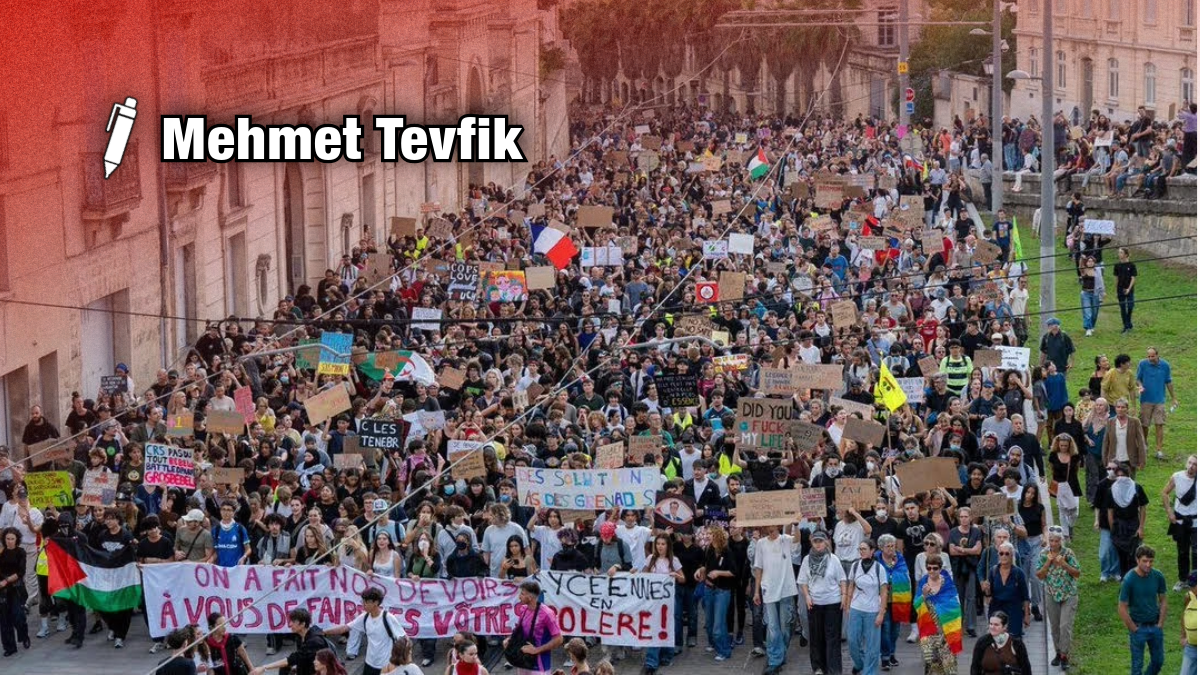
Consequently, after the protests of September 29 and October 1—which were largely limited to banlieue high schools and education workers (but still constituted a serious show of force with hundreds of high schools blockaded)—the movement experienced a significant leap forward on October 6. For example, students mobilized even at Henri IV High School, which is rarely a site of protests, and is both the best and probably the wealthiest high school in France. Also, for the first time on October 6, parents began participating en masse alongside high school students. Universities took the stage with immense force; in addition to protests spreading to almost all universities, 57 universities across the country were either occupied by students or closed to entry and exit. Organized workers from various sectors, ranging from hospitals to ports, also stepped in with their own contingents as an important part of the high school protests.
In the latest protests on October 17, major union federations—notably the CGT and SUD—became direct parts of the action with their own marches, joining the high schoolers who continue to form the striking force of the movement. It is worth noting that the CGT, in particular, proved hesitant on this matter - a hesitation that was heavily criticized. During the October 6 protests, union leader Sophie Binet refrained from saying they would participate on October 17, instead pointing to November 5—protests they would organize a full month later. However, despite all the hesitations of the union leadership, the fear of facing a backlash from the rank and file likely pushed the unions to participate directly in the high school protests.
The Spirit of the Yellow Vests and Street Violence
This actual unity between the working class and the banlieue youth, which is still quite fragile and in its developmental stage, has an important aspect not just regarding general political positioning, but also concerning day-to-day struggles on the street. Previous articles in Gerçek newspaper addressing the banlieue riots noted that the urban poor defeated fascists in street battles, reminding readers that this was directly related to the banlieue youth's skill in street violence. The recent wave of protests, especially on October 17, reminded us of this capacity for street violence once again.
On October 17, according to union estimates, 500,000 people participated across the country, making it the most massive day of action since the wave began with the high school protests. On this day, the street battle between the state’s forces and the people took place with an intensity rarely seen. What matters here is not the police violence, which has now become almost routine, but the crowd's response to it. Strikingly, as far as we could determine, protestors managed to enter various government buildings representing the ruling power in at least five cities: Marseille, Bordeaux, Lyon, Lille, and Limoges. While the people entered the city hall in Marseille, protestors who managed to get inside the governor's residence in Bordeaux vandalized it. In Paris, protestors tried several times to directly reach the Presidential Palace, the Élysée Palace, but were unsuccessful.
In the numerous waves of protests spanning the recent years mentioned at the beginning of this article, moves directly targeting government offices—attempting to storm the Presidential Palace, so to speak—were only seen during the first few weeks of the Yellow Vests protests in 2018–19. However, while the Yellow Vests also targeted various state buildings, they were almost never successful, if we are not mistaken (there may be incidents that occurred in small towns and villages that escaped our notice). Now, the brief occupation, looting, or setting on fire of government offices in five separate locations in a single day—including two of France's three largest cities and four of its top ten largest cities—is an absolute first.
The changing dimension of violence on the street is not limited to symbolic government offices being targeted. In the street wars taking place in France, for perhaps the first time since the early weeks of the Yellow Vests, the public achieved serious successes against the police on October 17. Of course, one cannot speak of winning the war over the streets just yet. But in individual street battles, law enforcement forces were forced to retreat and abandon some streets under a flood of stones and bottles and in the face of the people’s assault with unprecedented frequency. Footage of a street clash in Marseille, which spread rapidly on the internet, is a striking example of this. Beyond individual clashes, it was reflected in the press that law enforcement forces lost control of the streets in a series of situations, and tear gas canisters—which failed to deter the public despite being used heavily—depleted to dangerous levels in some cities. For this precise reason, military vehicles carrying machine guns in Marseille and special units specialized in street clashes in Paris were deployed during the day on October 17 after the difficult situation the police fell into became apparent.
At this stage, it is still impossible to say precisely where the protests will evolve. The movement faces multiple dangers. As has happened a few times before, a wave of protests that began with great power could be dampened by the French state, which combines police violence with political maneuvers. Furthermore, this wave of protests, which utilizes violent methods more widely, could trigger a counter-move from fascists and pre-fascists waiting ready to take revenge if it is defeated. However, risks aside, the unity France has been waiting for over the last decade has begun to materialize for the first time. A critical threshold has now been crossed in forming that great alliance where the youth of the banlieues and the working class extend a hand to one another. If this unity can be preserved and advanced, the working people of France could bring the enemy to its knees years later.
17/10/2026