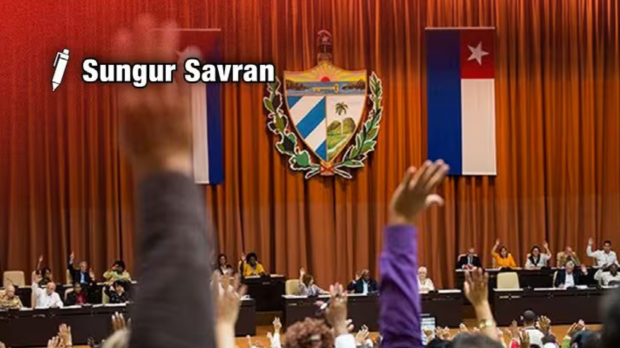
The conjuncture that emerged from the US’s blockade of Cuba that began in January entered a new moment on June 19th. But the defining feature of this moment is not a new move by US imperialism, e.g., expanding the blockade into new areas, or besieging the island of Cuba with its navy. It is an internal step, deeply internal. From within Cuba, from within the government, from within the Communist Party of Cuba, who still holds the power in its hands. On June 19th, the highest organ of power, the Assembly of People’s Power, unanimously voted on 176 separate resolution drafts, and unanimously approved all. The entire press wrote that the Communist Party of Cuba was entirely approving of these measures. The Prime Minister Manuel Marrero Cruz presented the resolutions. President Miguel Díaz-Canel defended the bill of resolutions with a speech that emphasized the correctness of the overall orientation that the resolutions represent, and noted that this direction was already late in the agenda, despite having been discussed ever since 2011. Most importantly, Raúl Castro himself announced his full support for the set of measures - Raúl, that is, the 95-year-old former President, and the person who is still alive from the original cadre of the Cuban Revolution (1958-59), and the person with whom the US was indirectly (through his relatives from younger generations) negotiating, and about whom the US indicted in late May. All of this is to say: the new move came from the highest loci of power.
And with this move, the orientation that would open the path to capitalist restoration in the country became the official policy of Cuba.
What is in the set of measures?
We have not seen all 176 measures anywhere, including the renowned central publication of the Communist Party of Cuba, Granma. But we think that both the Cuban press as well as the world press (first and foremost the Latin American and Spanish press) did sum up the most important measures in this bill. Let us put it this way: the content of the measures that have been published in various press agencies is so striking that it is not necessary to know the rest. There may be a few that are still obscure and even worse, but the ones that are announced are more than enough to understand the overall direction. Let us take a glance at a few that captured our attention:
-
In the past, foreign capital could get approval for investment only in partnership with the socialist public sector. Now, foreign investors can invest freely without partnering with the public sector.
-
In the past, the banking sector was in the monopoly of state banks. Now, for the first time, it is allowed to set up private banks.
* State-owned assets can now be sold to private or legal persons. This category includes Cubans settled in other countries. What this means is opening the path to the privatization of the state-owned businesses, as well as other public assets (public real estates, land, and other assets), just like in capitalist states that pursue a neoliberal policy.
-
In socialist countries, ownership of land is a vital element of the system in both the city and the country. In Cuba, a real estate sector that will operate in real estate sales is allowed for the first time.
-
While the state retains ownership of land in the countryside, forestry, sugar cane, fishing, tobacco and agro-tourism will be opened up to the private sector.
-
The cap on employment for private companies is now lifted. The “micro, small, and middle-sized businesses” that were allowed for in the 2010s could employ a maximum of 100 workers. This is the cap that is now lifted. Whoever is wealthy enough can employ thousands of workers in Cuba now.
-
Cuban citizens can now own more than one business, and control more than one firm through stocks in companies.
-
Joint-stock companies are now allowed.
-
The bosses can now freely hire and fire.
-
State monopoly over foreign trade is now lifted.
-
The public firms will be given commercial company status.
-
Cubans and foreigners will be able to buy stocks in state-monopolized companies.
-
Price control is lifted. Instead, the poor will be supported through targeted subsidies.
If all these measures enumerated above are fully implemented, it will be impossible to talk even about the “s” of socialism.
The ABC of the bill of measures
Not everyone is an economist. Nor does anyone have to be. Therefore, we will try to explain to our reader as plainly as possible the truth: namely, that this bill of measures opens the path for capitalist restoration.
In every country that has entered the path of socialist construction (beginning with the Soviet Union, but also China, Vietnam, North Korea, Yugoslavia, Albania, a host of Eastern and Central European countries, and a few other more debatable cases), the economy was for the most part modeled on the economic structure set up in the Soviet Union during Lenin’s time. The definition of socialism is a final end to the socio-economic rule that renders the entire direction of the economy to the wishes of capital accumulation through the exploitation of the working class (that is, seizing its surplus value without compensation) by units of capital, big and small. Therefore, the main feature of a socialist economy is the abolition of both private property (which makes it possible to use the means of production as capital) and a class of wage-laborers, who live off selling their labor-power to capital. Without private capital, an economy based on market mechanisms is also meaningless. Therefore, the defining condition of socialism is an economy where the ownership over the grand means of production (industry, agriculture, mining, transport, high technology, etc.) and circulation (banks, commerce, etc.) is in public hands, and where the entire economic life is ordered around central planning.
Now let us take a breath. A vast number and variety of concrete factors can lead to different combinations of public property + planning on the one hand and private property + the market in different countries. The important thing is not the existence of the same structures in the same proportions and combinations across different countries and levels of development on the path to socialism. The important thing is whether or not the power of capital is broken, whether or not the exploitation of labor is banned even if gradually, and whether or not public property and planning have gained supremacy over the market.
Therefore, a socialist government can at times tighten or loosen public control. Nonetheless, it is imperative that the government does not concede what Lenin calls the “commanding heights”, i.e., the control centers of the economy, to private capital, and that it retains control of production, banking, and foreign trade. Some shameless defenders of “socialism” use the necessity of these tactical maneuvers as an excuse to make it possible for capital to furiously exploit labor. What they are hiding is this question of who is in control.
A shameful debate
Now we can return to the bill of measures Cuba adopted on June 19th. While defending the measures, President Díez-Canel has emphasized a point that seems innocent compared to all others. He has said that there will no longer be price control to provide the vital necessities of the poor people to a certain degree, that the prices will be uncapped, but the poor will be supported through targeted subsidies (income transfers). And he has tied this to one of the most fundamental and famous questions of socialist economy: he has claimed that “egalitarianism” is wrong, that attempting to render the wages equal for everyone is detrimental to the work effort, that material incentives are necessary for productive work, and that moral incentives alone are not enough to keep up the work.
We truly wish he hadn’t uttered these words. We truly wish he hadn’t uttered them in this way. If Che were alive, the President would have received a good scolding from him. Che holds many a special place in the history of socialism. One is that he relentlessly, jealously, and furiously said and wrote time and again that material incentives were reproducing the human type that was the heritage of the old class society, and that the real point was to create the “New Human”. He influenced Fidel himself about this matter so much that when other societies in transition to socialism in the world over began to take measures that were called “market socialism” and slowly started to rot planning from inside in the early 1980s (from 1978 onward in China, and even earlier in Hungary and Yugoslavia), Fidel switched into an economic policy called “Rectificación” (Correction). While everyone was leaning into market and private property, he took the opposite route and increased the role of planning and the public in Cuba, and pushed back against the market!
Now, the first President of this country that came after the original revolutionary generation is claiming: “Well, moral incentives are just not doing it”, as if he is initiating a brand-new debate! Well, good morning! How original!
The question is not about moral vs. material incentives; it is about capitalism vs. socialism!
Yet, however important the matter of labor incentives may be, it is trivial compared to the 176 bullets shot at socialism that is the measures bill.
Let us draw the attention of the reader that many of the measures listed above are geared towards establishing a capitalist sector of grand proportions. All we will do is to gather together from the list of measures we have enumerated above the ones geared towards establishing and fortifying a big capitalist sector in Cuba - one that has not existed since the country took and radically implemented the economic measures of socialist transition in 1961.
-
The cap on employment for private companies is now lifted. The “micro, small, and middle-sized businesses” (that is, small businesses and self-employed petty bourgeoisie, “mypymes” in Spanish) that were allowed for in the 2010s could employ a maximum of 100 workers. This is the cap that is now lifted. Whoever is wealthy enough can employ thousands of workers in Cuba now.
-
Cuban citizens can now own more than one business, and control more than one firm through stocks in companies.
-
Joint-stock companies are now allowed for.
-
The bosses can now freely hire and fire.
-
State monopoly over foreign trade is now lifted.
-
The public firms will be given commercial company status.
-
Cubans and foreigners will be able to buy stocks in state-monopolized companies.
-
In the past, foreign capital could get approval for investment only in partnership with the socialist public sector. Now, foreign investors can invest freely without partnering with the public sector.
-
State-owned assets can now be sold to private or legal persons. This category includes Cubans settled in other countries. What this means is opening the path to the privatization of state-owned businesses, as well as other public assets (public real estate, land, and other assets), just like in capitalist states that pursue a neoliberal policy.
Do you see how comprehensive a plan to capitalize the economy this is? While these measures, as well as possible others whose importance the media could not comprehend, are in place, pulling the debate to the level of “Are material or moral incentives better to make the worker’s labor more productive?” is nothing but obscuring the matter.
From now on, the process has reached a new moment. If the measures are fully implemented, Cuba is for sure to experience capitalist restoration. If.
June 28, 2026