The following article was published in French on the website La Pensée libre (https://la-pensee-libre.over-blog.com/2026/01/n-270-le-fascisme-mute-du-21e-siecle-des-etats-unis-de-trump-a-la-fascisation-de-l-occident-collectif.html). Abdelatif Rebah is Algerian, from the “Échos de la vie ici-bas” (Echoes of Life Here-Bellow) Collective in Alger. The translation from French into English is by Ana Bazac. The introductory paragraph of La Pensée libre has been omitted.
Labelling Donald Trump's United States as fascist is not an error of analysis but a theoretical starting point that requires historical and material updating.Fascism is not a static artifact of the 1930s: it is a political form that capitalism adopts when its contradictions become unmanageable by the ordinary mechanisms of liberal bourgeois democracy.
What is unfolding under Trump is thus a mutated fascism, adapted to the conditions of the 21st century, the era of financialisation, hybrid warfare, the climate crisis, and the relative decline of American hegemony.It does not reproduce the classic forms of historical fascism, but reactivates its essential functions: the crushing of social opposition, the authoritarian reorganisation of the state, and the reactionary mobilisation of the masses in the service of capital.
In this configuration, the state does not formally suspend democracy;it empties it of its substance while preserving its appearance.The institutions remain, but their use is transformed.Executive power is hypertrophied, the judiciary instrumentalised, checks and balances delegitimised, while state violence becomes a common mode of governance for certain segments of the population.
Attacks against LGBTQ+ people, questioning of reproductive rights, stigmatisation of Muslims, normalisation of racism and tolerance towards supremacist groups are not cultural deviations but precise political operations: they produce a hierarchical, naturalized social order, where inequality is presented as a moral or civilisational fact.
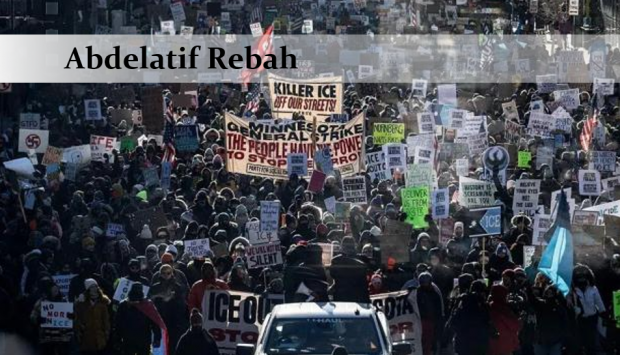
Fascism also operates through the destruction of collective mediation within the world of work.Unions are weakened, criminalised, or circumvented; labor law is stripped of its protective power; and precarious employment becomes a disciplinary tool.In this context, immigrant workers play a central role.Their overexploitation is made possible by a specific repressive apparatus, ICE, which functions de facto as a state militia.In Minneapolis, this federal militia continued its deadly operations despite massive popular mobilisation, exemplifying the normalisation of state violence against ordinary citizens.This violence, carried out with Trump's explicit political blessing, targets not only migrants but the entire working class.It serves as a reminder that rights are revocable and conditional upon obedience.
This militarisation of internal repression is accompanied by a growing hostility toward scientific research, critical thinking, and any production of knowledge that contradicts the interests of dominant capital.Climate denial, the marginalisation of scientists, and the brutal politicisation of truth are not the result of ignorance but of a strategic choice: when science becomes an obstacle to the accumulation or ideological legitimation of power, it must be neutralised.
On the international stage, Trump's mutated fascism unfolds in the form of impudent imperialism.International law is trampled, multilateral agreements are abandoned, and economic sanctions and military aggression against sovereign states are used as ordinary instruments of domination.This external brutality is inseparable from internal brutality: a single state, confronted with the erosion of its economic and strategic power, simultaneously hardens its domestic and foreign policies.War becomes an extension of capital's crisis management.
This model is not confined to the United States.It tends to spread throughout the collective Western world, and particularly in Europe, where we observe converging dynamics of authoritarian hardening, social repression and ideological fragmentation of the world of work.
In France, fascism is taking a particularly sophisticated form, centered on Islamophobia and an increasingly unabashed anti-Algerian sentiment, which have become central instruments of media and political propaganda.These discourses are neither simple cultural racism nor isolated rhetorical excesses: they constitute an ideological apparatus serving factions of the bourgeoisie linked to major industrial, financial, and media groups.By constructing Muslim and Algerian-origin populations as an internal threat, these currents shift social conflict away from class relations and the responsibilities of capital.
This strategy simultaneously legitimises increased security measures, restrictions on civil liberties, and the attack on what remains of the social gains and collective rights achieved after the war. Under the guise of secularism, republican order, or the fight against “separatism”, the state strengthens its repressive apparatus, normalises mass surveillance, criminalises popular mobilisations, and prepares public opinion for further social regression. State Islamophobia functions here as a tool of governance: it weakens and divides the working class, pits national and racialised workers against each other, and prevents the formation of a unified social front capable of resisting the systematic dismantling of social protections.
The mainstream media, largely controlled by bourgeois oligarchs, play a decisive role in this process.By saturating the public sphere with identity and historical debates, they normalise social violence, render class struggle invisible, and transform the victims of neoliberalism into scapegoats.This ideological offensive accompanies a clear material reality: the dismantling of pensions, the erosion of public services, the precariousness of work, and increased repression of labor and grassroots movements.
In England, the authoritarian shift has manifested itself in laws severely restricting the right to strike and demonstrate, an openly punitive immigration policy, and increased centralisation of executive power under the guise of regained sovereignty after Brexit.Nationalist rhetoric there serves as an ideological substitute for the collapse of social compromise, masking the widespread precariousness of work and the deepening of inequalities.
In Germany, the situation is particularly serious. The resurgence of openly neo-Nazi organizations and rhetoric, their electoral gains, and the growing tolerance of the state apparatus towards them signal a significant historical rupture. The criminalisation of the radical left, the repression of pro-Palestinian mobilisations, and the geopolitical and military alignment with Western imperialist interests contribute to a climate in which authoritarianism is becoming normalised, while the memory of historical fascism is being relativised or exploited.
This 21st-century fascism requires neither a single party nor total mobilisation of society.It relies on surveillance technologies, social fragmentation, security ideology, and the constant spectacularisation of politics.It governs through fear, exhaustion, and division, while leaving the domination of the bourgeoisie intact.
In this sense, Trump is neither an anomaly nor a mere parenthesis: he embodies an advanced form of authoritarian management of a capitalism in crisis, whose European manifestations confirm its widespread nature and historical depth.The conditions for his overthrow depend above all on the capacity of the American people to organise collectively and act decisively.
Thus, in front of the aggressive collapse of imperialism, the international convergence of revolutionary, progressive, and environmentalist popular forces is a historical necessity.This unity of action must forge, against the divisive propaganda of the bourgeoisie, a class-based, anti-imperialist, conscious, and disciplined front.Rejecting compromise and opportunism means affirming that only the organised struggle of the masses can bring about the necessary break with the decadent order.Transforming the crisis into a revolution requires replacing imperialist chaos with the construction of a popular power, where the satisfaction of human needs replaces the logic of profit.Unity in action is the condition for victory.
January 26, 2026