There are “moments” in history that stand apart. Moments that run counter to the Aristotelian concept of the moment, where time, at the boundary between past and future, shrinks into a dimensionless and timeless “now”. These exceptional moments of time and history cease to be mere incidents and turn into great Events – with a lasting impact on political and social developments.
On 6 December 2008, the cold-blooded shot fired by the policeman Korkoneas into the body of 15-year-old student Alexandros Grigoropoulos ignited a 33-day uprising across Greece – an uprising that remains an indelible Event in the most recent Greek history. Together with December 1944 – the culminating moment of the epic of the guerrilla struggle of 1941–49 – and the Polytechnic uprising of 1973, the December of 2008 forms a bright star in the constellation of the struggle of the oppressed for social liberation.
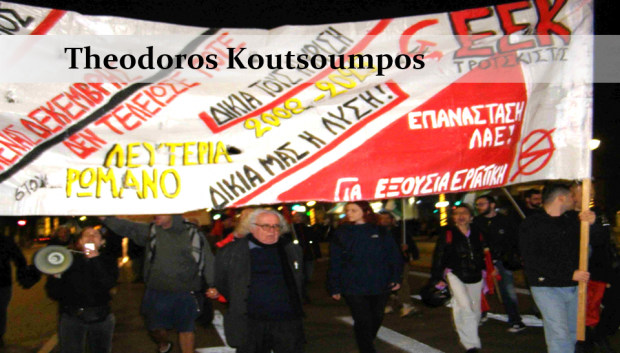
This year too, the 17th since the murder of Alexandros and the uprising, thousands of people took to the streets in demonstrations. Eight to ten thousand in Athens, more than 4,000 in Thessaloniki, thousands more across the country. Alongside the movement of the farmers who have set up roadblocks on the national highways – and the potential workers’ movement, which has yet to find a way to express itself – they constitute an explosive social force…
“These days are Alexis’ days – the movement has not spoken its final word,” chanted thousands of voices – only to continue with “freedom for Nikos Romanos” – the friend and classmate in whose arms 15-year-old Alexandros breathed his last. Nikos Romanos is being held in vindictive pretrial detention in Korydallos prison. Alongside these, slogans were shouted against the murderous capitalist state and the uniformed corps that the Mitsotakis government deployed by the thousands, and for the overthrow of Mitsotakis himself. And slogans that recalled the police and fascist murders of Koumis and Kanellopoulou, of another 15-year-old, Michalis Kaltezas, of the Roma children upon whose bodies police bullets supposedly “ricocheted”, of Vasilis Maggos, and of Pavlos Fyssas, murdered by the Nazi thugs of Golden Dawn.
At the same time, there were slogans of solidarity with the struggle of the Palestinian people – for freedom in Palestine and denunciation of the murderous complicity of the US and EU imperialists, and of the Greek government, with the Zionist killer state of Israel.
From the moment the march set off from the Propylaea, strong units of the riot police (MAT) were walking alongside the demonstrators. In front of Parliament, at the spot where the names of the 57 dead of the Tempi crime have been written, units of YMET (reserve riot police) desecrated the space so that no one could approach. When the march reached Parliament they were reinforced with more MAT squads – even though no one moved towards that direction. Obviously, it was Chrysochoidis’ “strategy” to show that he is “doing his job”…
The march was joined by left-wing communist and anarchist organisations and collectives – followed by a few groups formed from the fragments of SYRIZA. The KKE did not participate, maintaining the hostile stance it has held since 2008 – back then, Rizospastis considered the uprising a provocation and even published a “short story” in praise of the poor cop who punished the… “rich kids”!