This article was written in Turkish at the beginning of March and published on 10 March on the web site of DIP (https://www.gercekgazetesi1.net/uluslararasi/uluslararasi-che-guevara-tugaylari). Now that Silvio Rodríguez, the legendary Cuban folk singer-composer has taken the initiative of taking up the combat rifle against US intervention, we think the proposal made in the article by our comrade has become more timely for international audiences than before.
Trump shows no sign of stopping. He is in a hurry, both for political reasons and due to his advancing age. He is now targeting countries not one by one but in pairs. After abducting Venezuelan President Nicolás Maduro on 3 January, he once again turned his attention to Iran. But at the same time, by imposing an embargo on Cuba, he has left the island nation without oil, natural gas, and consequently without electricity, petrol or diesel.
If the Trump administration begins ‘talks’ with a government, no one should rejoice; on the contrary, one needs to think long and hard. The negotiations with the Venezuelan president stretched over more than three months. During their sole personal telephone conversation, Trump even expressed his admiration to Maduro, remarking, ‘What a powerful voice you have,’ as the American media later reported. Maduro, in turn, danced and sang for Trump as a gesture of peace. His voice is quite awful, but it’s only natural that Trump should have no taste in the field of music, especially the music of other climes. In the end, Venezuela’s president was abducted and locked up in a New York prison that, in terms of human rights violations, would put the worst prisons the world round to shame. Whether he is now singing there amidst grassroots black “pushers” of drugs and white mafia scum—mid-rank gangsters hostile to blacks—is of course unknown to us. We defend his rights and demand his return to his country and his post, but we do not know whether his former comrades, who now run the country, will accept him back.
One has to think hard and long once “talks” start, we said. In the early days of February, a weekend saw the US-Iran war come within a hair’s breadth of breaking out. Yet talks were still taking place. When the negotiations stalled, Trump sent a message to Ali Khamenei, the Supreme Leader, Iran’s most authoritative figure: “He should be worried”! It was clear that this was a warning to the prospective victim, much like the code of conduct in gangster culture. Indeed, when war finally did break out at the end of February and the beginning of March, Khamenei was assassinated along with a significant portion of the team governing the Iranian state.
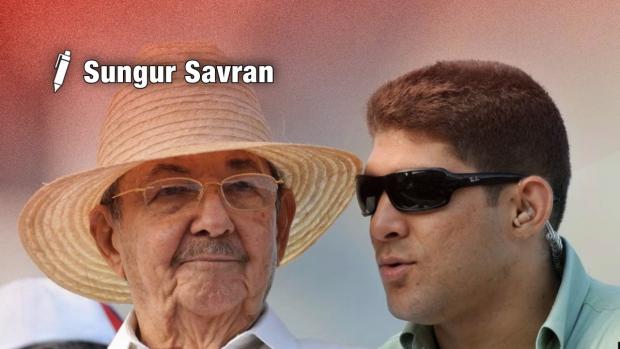
In recent days, however, a rumour regarding Cuba has spread across the globe. It was leaked to the press by the US government that the Trump administration had begun “talks” with the Cuban government. Since the revolution, Cuba had always been led by Fidel, the revolution’s greatest leader. After he fell ill and later died, he was succeeded by Raúl Castro (who was also one of the revolution’s leaders). But he too has grown very old; he is now 94. He stepped down from the presidency years ago, handing over the reins to Miguel Díaz-Canel, who rose through the ranks of the Cuban Communist Party.
However, negotiations are (or at least were) not being conducted with him or his government. Instead, they are taking place with one of Raúl Castro’s grandsons, a man who bears his grandfather’s name and is therefore known as ‘Raulito’ (‘little Raúl’). This gentleman, aged 41, is said to be well-connected in business circles. He is reportedly not rigidly committed to communist principles. In fact, the matters under discussion are entirely practical, so the rumour goes. As some may know, US Secretary of State Marco Rubio is the son of a Cuban immigrant family. Reportedly, it is he who is conducting the talks (probably in Spanish).
Cuba is unlike any other country. The people of this nation, right on the doorstep of the mighty US, carried out a revolution under the leadership of Fidel Castro and Che Guevara, expropriating the country’s bourgeoisie, which had been acting as America’s agent on the island. For 67 years now, the revolution has stood up to American imperialism and world capitalism. When socialism existed as an intricate system of different countries until 1991, the challenges of a poor island nation’s survival could be resolved through international solidarity. But first the Soviet Union collapsed, and then, when the US-backed coup in Venezuela brought an end to that country’s provision of oil to Cuba at a favourable price—in return for Cuba’s work in social services, particularly healthcare, in poor neighbourhoods—matters took a turn for the worse. Of course, the US is not merely applying economic pressure. It is imposing an absolute oil and gas blockade on Cuba. It is a true farce that the imperialist US, which has been making a fuss for the last 80 years about the benefits of ‘free trade’ for humanity, is now trampling international law underfoot to impose such an embargo.
In the face of this ‘negotiations’ farce, the workers’ parties, communists, socialists and revolutionaries of the entire world must now remain vigilant. Even if an agreement is reached between the US administration and Cuba, an attack on the country remains a possibility. Indeed, it could even be argued that such an attack is inevitable. The Trump-Rubio duo may have adopted this “negotiations” route to lower the country’s guard. If so, the time for expressing solidarity by waving small banners is long past.
What can be done? In this period when Trump is marching towards a world war at breakneck speed, the right course is to put forward and rapidly build the most advanced form of solidarity. Political parties across the world that have adopted it as their duty to defend the workers’ state in Cuba must come together to form a military force for the purpose of defending Cuba. Cuba has always helped countries in difficulty. In the early 1960s, Che personally fought, along with a contingent of Cuban soldiers, in the ranks of the anti-colonialist movement in the Congo for a full year after Lumumba had been assassinated. It was the deployment of Cuban forces to south-west Africa from 1975 onwards that enabled Angola to win its war against the colonialists and the South African movement to end apartheid.
Now, it is our turn. It is the turn of the working class of the rest of the world. Let us act together against the embargo, against the possible invasion of the island, and against the overthrow of the workers’ state. Let us take inspiration from the International Brigades of the Spanish Civil War and Revolution (1931–1939), one of the most honourable chapters of the previous century. And, of course, the most appropriate name for these forces would be the International Che Guevara Brigades, in honour of Ernesto Che Guevara—the greatest internationalist revolutionary of the second half of the 20th century, whose name Cuba and all of Latin America have gifted to humanity.
In this way, as communists, we will have taken an early step in the fight against imperialism’s World War Three.