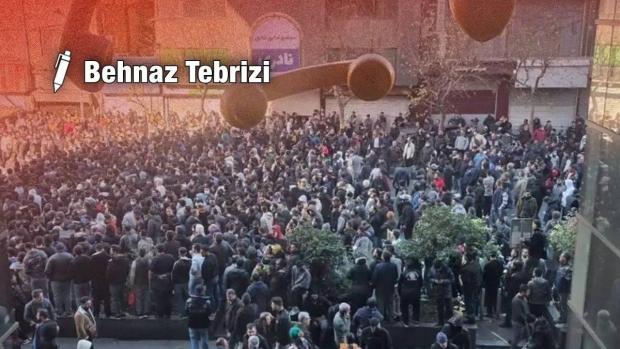
For more than ten days now, the people have once again been on their feet in many cities across Iran. These uprisings, which recall the November 2019 events yet are unfolding with a different dynamic, perhaps need to be assessed in a much more careful and distinct manner.
In November 2019, during the “Bloody November” events, people in Tehran’s poor neighborhoods were setting banks on fire. Centers belonging to the volunteer branches of the Revolutionary Guards were being burned down, workers were going on strike, and universities were taking to the streets with strong and meaningful slogans.
The protests that began at the end of 2025, by contrast, started with small tradespeople in Tehran’s Grand Bazaar. This segment in fact had a single demand: the stabilization of the exchange rate. Because pricing goods with a rate that changes every day had become almost impossible. While for years not even a single low-level manager had been dismissed despite hundreds of workers’ strikes, this time the state hastily replaced the governor of the Central Bank.
The opposition, circling abroad like vultures, has today gathered under the banner of the country’s former dynasty, the Pahlavis. While Reza Pahlavi maintains open and close relations with Israel, he was calling on the public to pour into the streets as Israel was bombing Tehran. Media outlets established with Saudi and Israeli capital, and still operating today, are polishing Pahlavi’s image and attempting to suffocate the Iranian people’s actions through manipulation. One of the first signs of this was the insertion of pro-Pahlavi slogans into videos using artificial intelligence. This particularly alienates and excludes the Azerbaijan region from the protests; for Pahlavi is not liked in Azerbaijan due to his Persian chauvinism.
Meanwhile, as Trump openly addresses the people in the streets, a tweet by former U.S. Secretary of State Mike Pompeo stating that there was “Mossad agent walking beside” Iranians protesting in the streets provided the authorities with the legitimacy to kill the desperate people in the streets with live ammunition. According to official statements, as of writing, hundreds have been detained so far and dozens have been killed.
The participation of universities in the protests is not strong; the slogans being chanted are not what they once were. Years of repression and oppression, during which every act of defiance was brutally crushed, have resulted in what we see today: spontaneous outpourings into the streets that lack organization even at the neighborhood level. On the one hand, pro-Pahlavi media abroad tell young people to “take to the streets,” while Pahlavi himself delivered his first message on the eighth day of the protests, calling on people to “chant slogans.” This picture shows that the opposition itself has also failed at organizing.
In an article published on RedMed in January 2023, we described the vultures flying over popular uprisings in Iran in the name of the opposition. Since then, their numbers have grown; many are actors, athletes, journalists, and others who held advantageous positions in Iran for years. Two years later, the people are once again in the streets; yet many balances have changed. The only thing that has not changed is the people’s struggle for bread.
The sanctions, which have increased for years and whose impact has been felt ever more deeply, have pushed the country’s infrastructure backward and made life unsustainable. Last summer, many cities experienced power outages lasting for hours; drinking water became one of the most critical issues. Air pollution is now depriving people of their most basic rights, creating an impact that extends not only to major cities but even to villages.
In addition to this, the application of two different exchange rates in the country, with the state providing cheap rates to certain sectors, has fueled systematic corruption. This privileged exchange-rate policy has led to the concentration of capital in specific segments while placing a heavier economic burden on the backs of the people.
At the same time, when Israel bombed Iran, the state left the people without shelters and failed to present any plan regarding even the most basic security needs. This further deepened the rupture. The automatic sending of headscarf warning messages to the public, even during bombardments, was a powerful indicator of where the state’s priorities lie. This picture caused the people to become further alienated from the state, not only through impoverishment, but also politically and emotionally.
On the first day of the protests, the state said, “we are ready to listen,” but immediately afterward it deliberately drew a distinction between the “objector” and the “looter.” By separating the protesting people from “shopkeepers,” it created a distinction between legitimate and illegitimate protest, once again turning its back on the working class. This language was nothing more than the reappearance of an old reflex based on dividing the people in order to govern, a reflex that deepens rather than calms the crisis.
The relative freedom that women gained after the Mahsa Amini uprising, especially in the sphere of dress, had created great hopes. Although the laws have not changed and the same rules still apply in official institutions, it is clearly visible that the concept of the “morality police” has de facto loosened. There were many attempts to manipulate this gain; yet it can be said that women, without deviating from their path, managed to secure an important part of their demands.
What is happening in Iran today is neither a foreign-fed “regime change” scenario nor a simple outburst of anger. This picture is the accumulated result of an infrastructure rotted by years of sanctions, systematic impoverishment, deepening class inequalities, and political blindness. At the same time, it is the direct product of the destruction of even the smallest forms of organization under the despotism of the Islamic Republic. The media’s constant glorification of policies against the working class, its rendering of labor invisible, and its legitimization of the existing order are an inseparable part of this process.
The absence of the left within the Iranian opposition, its systematic isolation, and the lack of any real base even abroad constitute one of the greatest impasses of the protests taking place today. While Trump and other vultures lie in wait for an opportunity, it is essential that the international left today possesses a much stronger line so that these impoverished people, being killed in the streets, can find their own path.
January 8, 2026