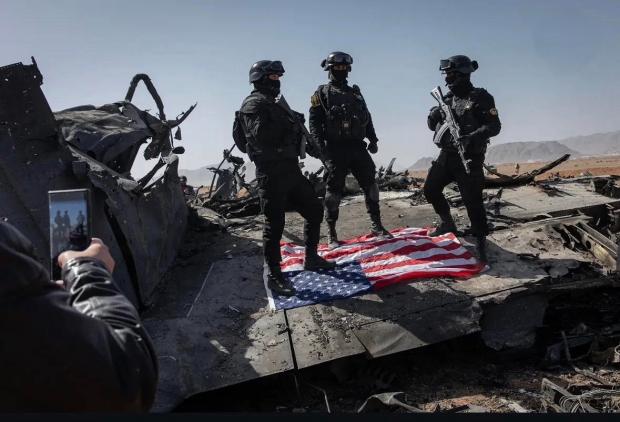
On April 5, a failed U.S.–Zionist operation in the Dasht-e Parzan area of Shahreza County, Isfahan, resulted in heavy casualties.
This short text is meant to advance the debate about the crossroads at which the Iranian left has found itself. The familiar discussion on the alignment of the international anti-imperialist program of communists, and the national revolutionary tasks resurfaces itself today in the context of the war of the US-Israeli regimes on Iran. One recent article titled “There Is No Middle Ground: Either Pro‑Imperialism or Defense of Patriotic–Regional Resistance!” poses the problem as a false dichotomy between “pro-imperialism” vs. “pro-Iranian state”, and offers a solution: equal distance to both warring parties. In a sense, that article poses an alternative dichotomy: “tail ending state powers” vs. “being equally distant to all warring sides”, with the latter approach seen as the correct communist strategy. In this article, we argue that this is an equally false assertion. We argue that important concepts of Leninism are misunderstood in catastrophic ways, reinforcing this false dichotomy.
We reject the false dichotomy put forward in the aforementioned article and instead propose the following two orthogonal axes: the axis of political independence and the axis of the stance on imperialism. Roughly speaking, the political independence axis takes two values which are: i) political independence of the working class (from all state actors), and ii) tail-ending certain bourgeois state actors. The imperialism axis concerns the understanding of the Leninist concept of imperialism, and the associated internationalist communist program that follows.
Our argument is that, from the perspective of revolutionary communists, the first axis is understood universally, yet there is a significant confusion regarding the latter. The confusion is to such an extent that a great deal of “revolutionary anti-imperialists” condemn states like Iran as “imperialist”. This is a mockery of the concept of imperialism. Lenin defines imperialism as a worldwide system. The distinctive feature of imperialism as the highest stage of capitalism is the focus on the export of capital as opposed to the export of commodities. At a certain stage of development, this export reaches such a degree that the (financial) capital owners of a nation enter the fight for the global control of markets and resources, and its state to fight for colonies and zones of influence. A worldwide struggle by capitalists, using the state machinery. Not a regional conflict!
Likewise, the associated internationalist program is very poorly understood, in particular the fact that Leninism condemns the idea of neutrality of the working class against two warring factions, even when they are both imperialists! In WW1, Lenin argued that one could not favor the victory of one side over the other. But he never argued for a passive neutrality, instead he directed the communists to turn this inter-imperialist war into civil wars in both camps. This is the Leninist program for when two imperialist sides fight against each other. But when an imperialist country attacks a non-imperialist country, the equation is completely different. In this instance, we can clearly see one outcome being immeasurably more favorable: the defeat of the US imperialist aggression, or in other words, the victory of Iran!
Once these distinctions are made, the confusion of the original article becomes clear: the author Yashar Darolshafa confuses the anti-Leninist “neutrality” with the Leninist “political independence”, and therefore condemns revolutionary communists who pick a side in this war as “tail enders of the Iranian state”. Now let us address the individual points made in that article.
Point 1: Does class politics ignore the unit of “nation”?
Abstract “class radicalism” has a universal and time-honored tradition of making light of the unit of “nations”. When one recognizes the internal conflicts and contradictions of a nation, it is a natural first reaction to deduce that, as opposed to the claims of nationalists, perhaps the nation is not such an important element of politics at all. One distinctive feature of Marxism over other radical political theories that relate to social classes, is its insistence on the importance of the state in class domination. And the concept of nations is a cornerstone of modern states in justifying their existence.
The arena of a “nation” is the first arena of mass politics for a working class party. We start organizing on a grassroots level, and we start thinking in terms of our local working class communities; we aim to build an international working class organization and get working people to think on an international level. Yet the concrete basis on which we operate is national, because we do not operate on idealized, imaginary notions but the real world which we inherit.
When the bastion of world imperialism, with its gigantic military apparatus, attacks any non-imperialist country, there is one question that needs an answer before anything else: is there any way to resist, or is the only option surrender? Every other question is subordinate to this question because the answer defines the space of plausible politics. If the answer is surrender, then it means there is no way of exercising communist politics, at least in the context of the non-imperialist country (say, Iran). The only way communist politics is possible, is if there is a way to resist and repel the enemy. An insufficient, but absolutely necessary condition of communist politics in Iran is to convince Iranian masses that they can beat the imperialist and Zionist enemies. On this issue, we are absolutely on the same side as the “resistance left”. But we take another step: we support the existing Iranian military organizations (in a military way if possible, or via propaganda and agitation at least) so far as they successfully fight the enemy. But we also criticise the organs of that same state that weaken this very same fight: the bourgeoisie and their political factions that are dying to find a way to “open Iran up” to plundering “civilization” of the West. And we never, ever, let go of our independence. We may form a temporary alliance but our program and our organizations remain independent. Our final goal is to activate and organize working masses to create workers’ states, not to convince Iranian elites and bureaucrats to follow “better” policies. This is where Leninists are different from the “resistance left”.
Point 2: Geopolitics is class politics
A significant effort of the young Lenin was spent against the so-called “Economist” faction of the social democratic party. Lenin argued that all major aspects of life, all aspects of national and worldwide events, are class-related, either directly or indirectly. Just as a faction of the world bourgeoisie supports the naked imperialism of Trump today, the international working class must form its opinions on any geopolitical development in the world. We don’t want the working classes to restrain themselves to only consider their wages, and unemployment rates. We want the working classes to relate themselves to every development in the world. Not because of abstract harmony of peoples, not for idealistic ethics, but because geopolitics is class politics.
We don’t want the working class to dissolve themselves into a nation-state, quite to the contrary, we want them to become the backbone of the nation-state. Just like the bourgeoisie domination shows itself as bourgeois interests posing as national interests, the future working class domination will take place when the working class interests are universally seen as national interests. We want the working classes to ascend to a ruling class, that is the essence of the dictatorship of the proletariat.
Point 3: War is class struggle
Wars are natural elements of international politics, and as such they are, in themselves, an element of international class struggle. What is happening in Iran is the assault of Western imperialist bourgeoisie. It is a class attack. The victory or defeat of this attack will be the victory or defeat of that class. It will also be the victory or defeat of the international working class.
But this is not the complete picture. We are not proposing an outcome that favors the international working class at the expense of the Iranian working class. We do not propose condemning the Iranian working class to the straitjacket of mullahs for eternity. Quite to the contrary! The victory of Iran will not only be the victory of the working class outside Iran, but also the victory of the working class in Iran. The victory against the imperialist enemy will prove the possibility of victories against all class enemies. It will reaffirm the importance of political action by the working class in Iran, it will reaffirm the notion that “a different world is possible”! Let us quote from Trotsky on this matter (in an article titled “Anti-Imperialist Struggle Is Key to Liberation” from 1938):
“I will take the most simple and obvious example. In Brazil there now reigns a semifascist regime that every revolutionary can only view with hatred. Let us assume, however, that on the morrow England enters into a military conflict with Brazil. I ask you on whose side of the conflict will the working class be? I will answer for myself personally—in this case I will be on the side of “fascist” Brazil against “democratic” Great Britain. Why? Because in the conflict between them it will not be a question of democracy or fascism. If England should be victorious, she will put another fascist in Rio de Janeiro and will place double chains on Brazil. If Brazil on the contrary should be victorious, it will give a mighty impulse to national and democratic consciousness of the country and will lead to the overthrow of the Vargas dictatorship. The defeat of England will at the same time deliver a blow to British imperialism and will give an impulse to the revolutionary movement of the British proletariat. Truly, one must have an empty head to reduce world antagonisms and military conflicts to the struggle between fascism and democracy. Under all masks one must know how to distinguish exploiters, slave-owners, and robbers!”
Point 4: Modern wars are fought with industrial weapons
I apologize to the reader for raising such an obvious point, but I wanted to keep the parity with the original text. Abstract “people” do not have weapons to defeat the US attack. It is yet to be seen whether they are sufficient, but the weapons in the hands of the Iranian state are necessary for this war. We support the defeat of the US. The Iranian army, a part of the state, is the central element of the equation that may lead to such a defeat. Therefore we support the Iranian state insofar as they concretely fight against imperialism. We do that, without disintegrating ourselves into the Iranian state, nor forgetting our vital and sharp criticisms of that state.
Point 5 & 6: Working class politics has to be national (and international!) before it can be victorious
We do not want the working class of Iran to be “national first”. This would mean the subordination of the working class to the bourgeois mold of the Iranian state. But we want the nation of Iran to be “working class first”. We want the “nation” to be subordinate to the political demands of the working class. This can only happen if the working class organizations concretely prove to the public that they are capable of responsibly handling and solving seemingly “national” problems, such as defense against aggressors, using its working class programme.
The toiling public, no matter how one thinks about them as ignorant or backwards, observe us as they observe all parties. When the Iranian “radical” prioritizes political hygiene and purity over the responsibility to act, they understand that the radicals are not, in fact, talking to them. They are talking to each other as part of a small social club. This is not revolutionary politics, this is merely a collection of habits due to defeats. It is true that we have been defeated in Iran, many times, in the past. But we cannot carry the chains of these defeats on our shoulders forever. Now is the time to be courageous once more, to be active and not reactive. Because it is still the time of revolutions, in Iran and in the world!